Sunday, July 18, 2010

On the way to Haines, Alaska

The last couple of days we have been traveling from Valdez to Haines, not far as the crow flies but almost 600 miles by road. We have to leave Alaska and the USA and enter the Yukon Territory of Canada. Next we pass through British Columbia and then get back into Alaska. Enter Canada Customs and a little later on pass through USA Customs. This time we passed through Canada without spending a cent and we had the easiest US Customs we've ever had. In Canada, our cell phones do not work. In fact, through most of Alaska the cell phones have no service. Therefore we could not reach anyone or hear from anyone. We talked to a guy who broke down on the Alaska Highway south of Alaska and it took FOUR days to get a wrecker. His Motorhome had to be towed to Whitehorse, Yukon, to the tune of $4800.00. His road service picked up all $2300.00. Then the work on his Cummins diesel was $8400.00. Four days for a wrecker!!! At lease he could eat and sleep in the RV.

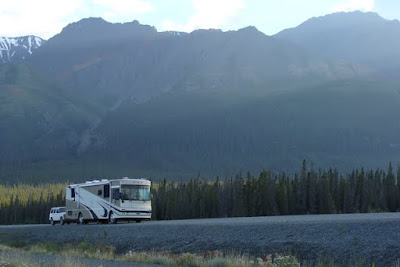
I was trying to get as many miles behind us as we could because there is really nothing to do between Valdez and Haines. Finally my crew was getting very tired so we stopped at a roadside rest area that doesn't forbid camping. It was one of the better places we've camped. The picture below is from the motorhome looking out.


This is from the water looking back.


Today we drove the rest of the way to Haines, passing this salmon machine on the way. This is built and owned by Indians who have been using such a device for many years. The current keeps the machine moving and is scoops up salmon and slides them into containers on each side. I've seen video of one of these working very well, harvesting two or three salmon in each scoop. This was one of two that were not producing as far as I could see.


Getting in around 10:00 AM, we were a bit early, so we parked in town and grabbed a late breakfast before moving to our campsite for the next few days which are the two pictures below.


I took a ride to the ferry landing where we will be boarding our motorhome and Jeep for a ferry ride to Skagway on Thursday. It's an expensive one hour ferry ride, but it saves a lot of driving and two days on the road. Next, I drove a few miles further to a river and a lake where red salmon, also called sockeye were being caught. It is Sunday and there were a lot of fisherman on my side of the river. There was also a HUGE grizzly on the other side of the river. Humans are not allowed to fish the other side of the river due to the bears. I'm going to fish MY side one day.

Friday, July 16, 2010

Pictures by Marla

Last week Helen and I took a glacier/wildlife tour out of Valdez, which I addressed in an earlier blog. We had the good fortune to have Marla and her family sitting in front of us. Marla is a resident of Valdez and gave us a lot of great information about what to see and do in the area. She took a number of pictures on the same cruise and some of them were excellent. Therefore, I am presenting them here. These are NOT pictures taken by Helen and me, but they are taken of the same subjects. Enjoy.

From Marla's Pics


From Marla's Pics


From Marla's Pics


From Marla's Pics


From Marla's Pics


From Marla's Pics


From Marla's Pics


From Marla's Pics


From Marla's Pics


From Marla's Pics

Thursday, July 15, 2010

On the way to Haines, Alaska

We finally left Valdez this afternoon after waiting for the mail truck at the post office. Mail that I've been waiting for still has not arrived so I made out a forwarding form to have it delivered to Haines. At Haines, I can probably have it forwarded back to my mail service and we can do this all again. Priority mail means NOTHING in Alaska, NOTHING!!! So under more rain, (what else is there?) we left Valdez. We were making good time when we got behind a humongous trailer heading up Thompson Pass. There was one truck in front, pulling, and another in the rear, pushing. They were going all of 15 mph. That's OK, it soon got so foggy that I could barely see the red lights on the car in front of me, and here's this truck taking up 3/4 of the road. I was waiting for the worst, but it didn't happen. Later we passed another wide load. This one had two trucks pulling. The rear truck was attached to the trailer and was connected to the front truck by a tow bar similar to ones used to tow a car, only much heavier. The rest of the ride was uneventful.

We are now in a rather tawdry campground east of Glennallan, 500 some odd miles from Haines. We have to be in Haines on Tuesday, so we should make it.

A couple of days ago I wrote two blogs on the same day. In talking with some friends, they were surprised when we told them about our visit with the bear family. When the visit our blog, they only go to the latest, thinking they have read all the others. I guess I threw a curve with the double posting. If you go back a couple of days you will see the blog and the pictures of our encounter with a mother grizzly bear and her three cubs. It was a high point in our trip and I think you'll enjoy it.

An early night tonight, sleeping under the G D patter of rain on the roof.

Monday, July 12, 2010

Worthington Glacier

Today Helen and I started out to climb up to Worthington Glacier, about 32 miles from Valdez. About 20 miles into the trip we came across Horse Tail Falls and Helen wanted to take a few pictures. In only a few seconds she was back in the car asking what the message on the camera screen meant. I looked and thought, Oh S**T. The last time I downloaded pictures I didn't put the memory stick back in the camera. twenty miles later we got back to the RV. I've been getting in the habit of shutting off the engine and coasting the last 100 feet to the camper. The dogs don't know I'm coming and they don't bark. If they hear us in advance, they raise quite a ruckus and I don't want that in the campground. The dogs were asleep, Coco on the couch and Jodie beside our bed. We had the couch covered so we didn't care. I got the stick and we were back on our way.

Below is Horse Tail Falls. This may be impressive, but there were waterfalls everywhere.


Below is a picture that shows the scale of the canyon to my little Jeep.


Helen, on the way up to the glacier.


This is where we are headed.


You will notice a lot of rubble on top of the glacier at this point. I wanted to get over to the ice, but this crevasse was in the way. Going further up the glacier was no longer an option.


Here's Helen posing on the glacier. We were both surprised to see all the rock on top of the glacier. It made for good traction, but it wasn't the white surface we expected.


And this is where water was rushing down the glacier and disappearing into this hole. I had to walk across this spot ans hoped that it was solid near the hole. It was.


Here's the old man of the glacier. I DID get to it.


Here Helen is showing her elation at getting to the glacier and getting back. It was more of a climb than we had expected and I know that I'm already sore in areas.


I drove Helen back to the motorhome and then I went fishing. The river that was so clear a few days ago was gray with silt today. I tried, but it was half hearted due to the water. I went back and picked up the family and we took the dogs for a swim. That ends another day at Valdez.

Salmon, Sealions and Bears, Oh My!

Yesterday started as a normal coastal Alaska day, cold and rainy. As Helen and I were walking the dogs, the aroma of bacon cooking wafted through the campground. We made an instant decision to have breakfast at the Totem Inn, a hotel and restaurant across the parking lot. The breakfast was delicious and they do breakfast a little different up here. Of course, after smelling bacon, I ordered Bacon and eggs, expecting two very, thin very crisp pieces of bacon. Instead I got six or seven pieces of slab bacon, much thicker than normal and delicious. I had to bring two back to the dogs and it was well appreciated.

Helen went shopping while I stayed with the dogs, and when she returned we went to Solomon Creek to see the Sea Lions that come in to feast on the salmon. The tide was in and there were countless people fishing so the sea lions stayed away. We went back to the camper for a few hours and returned around 9:00 PM.


There were about sixteen sea lions attending this feast and they were a sight to see. First of all, the pictures do not do them justice; they are HUGE, with heads as big as a grizzly bear. They would feast and feast until they were full, then they would grab another salmon and play with it, shaking it violently and sending its remains to the waiting sea gulls.

Next to the salmon stream is a fish hatchery where they process over 430 million eggs a year, and ending up with 250 million salmon fry that are released. That's quite a feat. About 35% of the released salmon return in the nets of the local commercial fishermen. Across from the hatchery is the Solomon Creek Hydro-electric plant. As a retired power plant operator I was very interested in this rather small operation. I rang the bell and Mark, the sole operator there, let me in. I had a very nice visit and learned how this electric plant worked. My plant was nearly one million megawatts, so this 12 megawatt plant was tiny by comparison. I learned a couple of things about the plant, and I also learned that each evening around 11:00 PM, a mother bear and her three cubs would visit the salmon run. It was almost 10:00 when I rejoined Helen and told her about the bears. We decided to wait along with about 75 other people.

I was watching the area near the electric plant where they were seen the night before. Right at 11, Helen noticed a commotion at the other end of the parking lot. We could see a small bear cub working his way along the shore.


Soon we could see his mother and a sibling following behind.


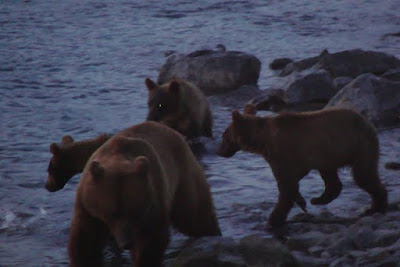
The third cub was bringing up the rear. For the most part, the four bears were not bothered by all the people, but at one point the mother let out a growl that sent a lot of people back.


This is the bear family, all in one shot. She is a Brown or Grizzly Bear. They are much bigger than the black bear, but for some reason they don't run into trouble with humans as often as black bears do.


We watched the bears for about a half hour. They caught and ate a number of salmon and we were thrilled to see the cubs catch their own. The mother would put her paw down on a salmon and then pick it up by the tail. Then she would carefully and almost daintily eat the salmon piece by piece. At one point, they were only 30 feet from our car, but there were people between our car and the bears. One fellow in his early twenties grabbed a salmon and presented it to the bears by walking closer to them. It was a silly stunt that had no ill effects, but his girlfriend was really ticked off. These pictures were taken without flash between 11:00 and 11:30 PM.

Having seen such a sight, we started back to the campground, but the day wasn't over yet. About half a mile out of town we saw two female moose in a marshy area beside the road. What a great day!

Saturday, July 10, 2010

More Good Times in Valdez

Below is a view from our campground. Bayside Campground. The campground is a little spartan, but the bathrooms are huge and the hot water endless. It's a small city and everything is close. The whole economy revolves around the end of the pipeline, fishing, and tourism.


I'm having a great time here in Valdez and I'm sure Helen is too. Yesterday was such a great day with ample sun and warm temperatures. Before midnight I had my fish at he processor as they are open 24/7 when the salmon are in. Naturally I was elated to finally luck into some good fishing, so getting to sleep was not easy last night. Then, I had to get up early to catch another glacier-wildlife tour.


This is a small picture of a very nice boat harbor. We found out that the F/V Northwestern was in port yesterday. This is one of the boats featured on "Deadliest Catch" with Sig Hansen. Neither he nor his boat could be seen today.


On the way to the glaciers, we passed a few boats using purse seines to catch the abundant pink salmon. There is a special hatchery across the harbor from Valdez where they raise and release about 150 million young pink salmon every year. It makes for a great economic fishery and allows a lot of sport fishing also.


All along the water's edge from the city of Valdez to the glaciers and everywhere in between, there are waterfalls where the snow we can't see is melting or the rain from the last few days is collecting or something. In any case, these small streams and falls were everywhere.


Here is my traveling companion, apparently enjoying the trip.


We could not actually get to the first glacier, Columbia. Columbia slid to the ocean creating a deep fjord and pushing a wave of moraine debris in front. The glacier has now retreated over ten miles from the moraine deposit, but the a boat cannot get to the glacier. Since it was a very deep glacier, the icebergs calving off have a great mass. The moraine deposit comes to within 40 feet of the surface, but since the icebergs draw a lot more water, they drift to the moraine line where they become grounded. Between the moraine deposit and the glacier it's like a lake. On the seaward side of the moraine there are ice chunks by the thousand, but the giants are stuck on the shallow spot. I thing the ocean side of the moraine goes down to 1000 feet or more.


One of the crew is showing us a piece of glacier ice that's hundreds of years old. It is so clear because over the years, the pressure has squeezed any air out of the ice.


This is the face of Meares Glacier, yet another from the same ice field. This is taken through the windshield of the boat. This is the first tour that we've been on where the passengers are welcome in the helm. It was very interesting to me.


Another picture of the glacier face. This glacier is over half a mile wide and two to four hundred feet high. Unlike Columbia Glacier, Meares only extends about fifty feet under water.


In such a bleak environment one would expect to see little signs of animal life. The opposite is the truth. Seals, sea lions, sea otters by the dozen, pods of Dahl porpoises, humpback whales, bald eagles, water birds and more. Though we didn't see them, the captain assured us that the woods adjacent to this waterway has deer, moose, black bear and more of them too.


These two otters were watching us as we watched them. They are here in great numbers because there is so much food for them in the form of crustaceans, starfish, sea urchins, and mussels.


On the way back in we caught these two young sea lions taking it easy on one of the security buoys marking the boundary of the Valdez Oil Terminal. Since 9/11, the Coast Guard is wary of anyone inside the boundary.


And here is the famous oil terminal. Not too impressive to me. I expected several super tankers being filled at one time. Instead, only one tanker was being filled and it was not of an impressive size.


We met a local family on the cruise and we got a LOT of useful information. Their oldest son is a member of the crew and the family was aboard with his visiting grandmother from So. Carolina. The mother had a lot to say about what to see and do in Valdez. Also, where to get the cheapest gas and diesel. To me, the most interesting gems were told to me by the younger son, who told me just where I should be fishing. Turn right at the ball park and just drive behind the park on the dirt road. It takes you to a river where fly fishing is required. It didn't take me long to stop by and check it out. It looks perfect! There were three locals fishing there and they were catching fish on flies. They claim that tide is not important since the place is upstream and I can't wait to stop again tomorrow.

We'll be spending a few more days in Valdez as there as there is so much to do (fishing).

On to Valdez

A few days ago I wrote a blog about moving from a place on the GlennAllen Highway to Valdez, but I didn't include any pictures. So, here is one Helen took along the highway while we were walking the dogs. In addition to the pretty flowers in the foreground, there are mountains way out back.


Further along and much closer to Valdez, we came across Worthington Glacier. I didn't realize earlier, but the glacier we were camped near the night before comes from the same ice field as Worthington. In fact, Matanuska Glacier is just another of many glaciers born from that ice field, including Valdez, Yale, Harvard, and more. Also interesting is that some glaciers are receding, some are extending, and some are stable. Global Warming???? I'm not so sure anymore.


Passing through the deep chasm on the approach to Valdez are a number of awesome falls. The one below is Bridal Veil Falls.


When we got into our campground, I noticed the kid in the next space putting away some fishing tackle. He was kind enough to tell me exactly where he was catching fish. I took a ride over there that night and found tons of salmon and two tons of fishermen. Also, there were a dozen or more huge sea lions feeding on the salmon, some only fifty feet from where I was standing. Of course I had no camera. I went back the next day and found the tide at dead low, as shown below.


The flat you see above is all underwater at high tide. This time I had my camera and my fishing tackle, but the only area containing fish was that area to the far right, which is part of the fish hatchery and thus, off limits. The only ones having a jolly good time are below.


This is what everyone is after, a pink salmon or humpy. I have no idea how this poor soul ended up high and dry, but he didn't appear to be damaged. Several salmon in the area bore the marks of a very close encounter with a sea lion.


I went back again after 10:00 PM and got my limit of six fish in a short time. Then it was time to clean the catch and return home. After filleting two, my fingers were numb and I was having trouble holding my knife. I figured the heck with it. I took it to a fish processor where I had them all filleted, vacuum packed in plastic, and flash frozen. Now the freezer is full! It costs two fortunes to have some fish shipped home but I'd like to continue to fish. The processing plant accepts fish for charities, so that's where the rest will go.